
Factsheet
Major City, Regional and Remote Populations

Australia’s population is shaped by where people live. Major cities, regional towns and remote communities each have distinct demographic patterns that influence everything from service delivery to workforce needs and community wellbeing. Comparing these areas helps us understand how population change plays out differently across the country, and why place-based planning is essential for meeting the needs of all Australians.
Key Figures
73%
of Australians live in major cities
25%
of Australians live in regional areas
1.9%
of Australians live in remote areas
City populations are younger
Capital city residents have a median age of 36.9 years, compared to 42.0 years for the rest of Australia
Population Pyramid
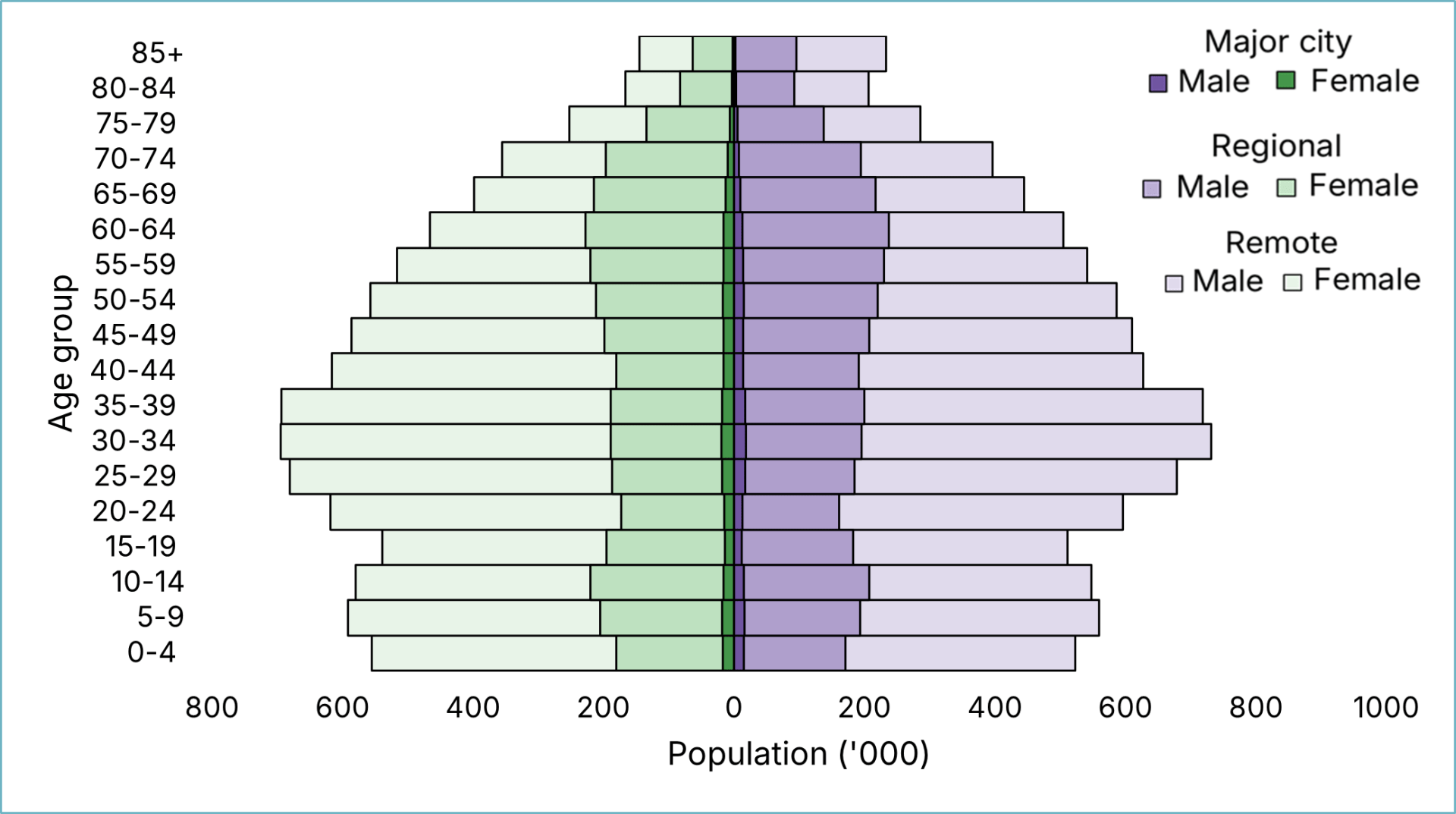
Population pyramid by major city, regional and remote area, by age and sex (Australian Bureau of Statistics)
References
- Australian Bureau of Statistics. (2023, August 15). Microdata and TableBuilder: Census of Population and Housing. ABS. https://www.abs.gov.au/statistics/microdata-tablebuilder/available-microdata-tablebuilder/census-population-and-housing
- Australian Bureau of Statistics. (2024). Regional population by age and sex. ABS. https://www.abs.gov.au/statistics/people/population/regional-population-age-and-sex/2024
- Australian Institute of Health and Welfare. (2025). Profile of Australia’s population. AIHW, Australian Government. https://www.aihw.gov.au/reports/australias-health/profile-of-australias-population